Dear Client:
After much ado in the beer industry (and from your editor, [see BBD 03-24-2025]) about the negative impact of the egregious Midwest Premium on aluminum pricing in the U.S. – and the subsequent cost being paid by consumers and manufacturers alike – Congress is now taking a look at the matter.
In a letter dated August 6, 58 members of the U.S. House of Representatives (signed by 42 Republicans and 16 Democrats) called on Department of Commerce Secretary Howard Lutnick to “investigate pricing irregularities in the sale of domestic aluminum, which may be artificially increasing the cost of goods for consumers across the country.”
The congressmembers referenced the Midwest Premium (MWP) – a separate pricing premium from the “global underlying price” of aluminum set by the London Metal Exchange (LME). The Midwest Premium is set by S&P Global Platts via “a formula that relies on bids and offers from upstream producers and traders to determine an average market premium for supply constraints, shipping, logistics and taxes.”
As BBD readers are familiar, the Midwest Premium also incorporates the Section 232 50% aluminum tariff imposed on aluminum regardless of the source of the aluminum, so even domestically-sourced and recycled aluminum are “priced no differently than imported aluminum” (regarding the latter, recycled aluminum is even charged the premium every time it is recycled and reused, something the BI calls the “recycling penalty”). Yes, it’s that ridiculous.
“This not only creates price constraints for U.S. manufacturers in need of aluminum, but it ignores domestic producers over importers – ultimately undermining the President’s goals of reindustrialization and manufacturing growth,” the congressmembers wrote. “Meanwhile, aluminum users and American consumers continue to face the unnecessarily inflated price.”
Ultimately the Midwest Premium (and its inclusion of Section 232 tariffs) coupled with supply chain constraints from global shortages and disruptions caused by the war in Iran “has contributed to record-high aluminum costs,” the congressmembers wrote.
They also called out the disproportionate impact of the Midwest Premium on certain U.S. manufacturers, noting that “the beverage industry, for example, uses more than 70 percent recycled content in its aluminum cans.”
As for their specific call to action, the congressmembers called for the Administration, “in consultation with the Commodity Futures Trading Commission and other relevant agencies, to investigate the Midwest Premium as part of its national security review of the aluminum industry. Included in the review should be an assessment of how the premium is calculated, price reporting methodologies and “and how it affects the use of recycled content.”
ALUMINUM INDUSTRY RESPONSE. In a statement to Packaging Dive, the Aluminum Association noted it has “no role in industry pricing,” including for the MWP. (That’s like A-B saying it has no role in pricing Mich Ultra).
“Regional transaction premiums are common in the aluminum industry around the world,” said Charles Johnson, president and CEO of the Aluminum Association, noting that “similar mechanisms are used to price other metals like lithium, cobalt, nickel and copper.”
Then too, the Commodity Futures Trading Commission, which oversees aluminium pricing in the U.S., “has not indicated any sign of market irregularities.”
For its part, S&P Global Platts told Packaging Dive it does not agree with how the congressmembers characterized the MWP in their letter to the commerce secretary.
“This letter demonstrates a fundamental lack of understanding of how aluminum markets trade and how they are assessed by Platts,” a spokesperson for the organization said. “Our methodology is publicly available, rigorously tested and aligned with the IOSCO PRA Principles – the global standard for commodity price reporting. The Midwest Premium provides a consistent, trusted benchmark for the market to understand value and manage risk.” (Platts is basically a trade publication. Again, that’s like saying Beer Business Daily should be setting the price of beer in the U.S.).
BI CALLS TO END THE RECYCLING PENALTY. While it has been calling for years for lawmakers to look into the Midwest Premium, the BI Friday said it was “seizing the opportunity to promote the importance of fair and transparent aluminum pricing” given recent congressional attention on the issue.
In particular, the BI has launched a new website aimed at ending the so-called recycling penalty, suggesting that “American businesses shouldn’t be punished for using recycled aluminum.”
The website plainly points out that because Section 232 tariffs “are baked into the Midwest Premium, the same aluminum is charged a duty again and again, every time it is recycled and reused” amounting to “a system that effectively punishes recycling instead of rewarding it.”
The website also points out to consumers who may be unfamiliar (of course us industry folk are well-aware) that the aluminum can itself “often costs more” than the beer or soda inside the can. That cost is being driven by a Midwest Premium that’s increased “more than 300% in three years” while aluminum prices have “climbed nearly 500% in five years,” per the BI.
The organization called on policymakers to “impose reasonable transparency measures, and provide relief to U.S. manufacturers who are unfairly penalized for recycling and making products in America. It’s time to end the recycling penalty.”
We’ll be monitoring. Stay tuned.
RAHUL: ENCOURAGING MORE CONNECTION HAS “NEVER BEEN MORE IMPORTANT”
Just before the weekend, Molson Coors chief Rahul Goyal took to LinkedIn with some thoughts on the state of social connection today, following the recent Financial Times piece spotlighting declining face-to-face interaction among young Americans.
Recall, the piece included the ‘stop-you-in-your-tracks’ finding that on an average day in 2023, one in 10 Americans ages 23-29 did not spend a single minute interacting face-to-face with another person [see BBD 08-19-2026].
And for Rahul, it’s a stat worth reading twice.
“Read that statistic again and think about how that’s shaped the world today,” Rahul wrote. “We’ve never had more ways to stay connected, yet too many people feel disconnected. More scrolling. Less talking.”
But while moments of connection have become “increasingly rare,” Rahul does not believe “the desire for connection has gone away.”
In fact, he sees evidence of the opposite, pointing to bars and restaurants as places where people continue to come together. “The continued strength in those spaces is a reminder of the value people put on connecting with one another,” he wrote.
And while “consumer habits evolve,” Rahul argues that “the desire for community and shared experiences is consistent,” whether that’s meeting colleagues for a drink after work, gathering to watch a game, celebrating a milestone with family or catching up with friends. “These moments matter,” Rahul wrote. “They create belonging. They strengthen relationships. And they remind us that some of life’s best moments happen when we’re together.”
Of course, Rahul sees beer as part of that broader call for connection, noting that since becoming CEO, he’s “made a point to champion beer and the special moments that bring people together.”
And it’s a role Rahul believes matters now more than ever. “For generations, beer has been part of these occasions,” Rahul wrote. “We’re proud to play a role in these meaningful moments, and I believe encouraging more connection, more community and more togetherness has never been more important.”
ANDREWS TAKES SOME “TOUCH” OUT OF DSD
One of the country’s largest Molson Coors houses says its bespoke “SlimSavr” check-in-by-weight system, built with pallet-truck maker Big Joe, could rewire how beer comes off the truck.
Andrews Distributing has spent the past year building what it believes is a real shift in direct store delivery, checking product in by weight rather than by hand count. The system pairs a purpose-built lithium pallet truck from Big Joe, the LPT40 DSD with an onboard scale, and a slim pallet Andrews designed itself. Together, the company markets it as SlimSavr.
(Note, this is the kind of operational bet that usually surfaces in a session at our biannual Distributor Productivity Summit, not necessarily in our daily newsletter. But we’re running it now because when one of the biggest houses in the country sets out to reset a 50-year-old delivery habit, it’s newsworthy.)
The whole pitch is about eliminating “touches.” Andrews runs roughly 600,000 deliveries a year, and by its own value-stream breakdown, drive time is about a third of the delivery process, product handling most of the rest, and check-in alone about 20%, which is the slice SlimSavr goes after. Today a driver pulls a fat pallet (in Andrews’ case a Molson Coors pallet) up to a c-store, down-stacks it in the parking lot, two-wheels it in seven cases at a time, then waits while a store manager hand-scans everything, sometimes tearing open cartons to find a UPC. Dan Betz, Andrews’ EVP of operations, calls all of that waste, or in the lean vocabulary the company favors, “Muda.”
The SlimSavr version skips the down-stack and the hand count that often occurs in the front of convenience stores and disrupts customer flow. Because every case is scanned and weighed in the Andrews warehouse, the truck already knows what the order should weigh. At the store, the skinny pallet rolls straight through the back door to the cold box on a light jack (capped in “turtle mode” at half a mile an hour for safety), the driver sets it on the onboard scale, and if the weight lands within a certain range of expected, the check-in is done. Andrews says it’s running 99.8% accuracy and has a TABC-blessed “no finger point” swap policy for the rare miss. (In a full year, Dan said, exactly one case got flagged, a stray box of State Fair Cotton Candy at a Buc-ee’s.)
Adoption is further along than some might expect. Andrews says 100% of Fiesta stores and 100% of Circle K locations across DFW and South Texas now check in by weight, along with most of its independents, with two more major c-store chains close. Molson Coors, Heineken, Constellation and Coca-Cola have all seen it and come away impressed, per Andrews, and neighboring distributors are starting to bite — like KEG 1 O’Neal. Big Joe’s own numbers claim fewer touchpoints cut delivery times by up to 43%. Andrews’ own math is more conservative but still meaningful. The company says a typical c-store delivery runs 1.5 hours with a two-person team, or three hours of combined labor, and SlimSavr cuts about 20 minutes off the two-person stop, or 40 minutes of total labor, roughly a 20% improvement.
“With successful testing over the last year, our customers appreciate the new streamlined check-in-by-weight process,” Dan said in the companies’ announcement, adding that his delivery team “loves the faster stop times and is more than happy to let Big Joe do the heavy lifting.”
For the rest of the tier, the question is ownership, and it doubles as the answer to why Andrews would hand rival houses a productivity edge. SlimSavr has two patented halves. Big Joe patented the pallet jack, which it built in collaboration with Andrews, so Andrews isn’t in the equipment business. “We’re here to sell beer,” as Dan put it on our call, not jacks. The slim pallet is the half Andrews owns. An Andrews spokesperson calls it “the star of the system” and says Andrews developed and patented the injection-molded design to slip through c-store doors and aisles and drop into existing DC workflows without retooling. Wholesalers who want the slim pallet order it directly from Andrews.
Andrews has a second reason to evangelize. When an adjacent distributor pushes the same shared retail customers (think RaceTrac, QuikTrip, 7-Eleven) toward check-in-by-weight, it speeds retailer buy-in for everyone. Wholesalers who want the jack go through Big Joe and its Dallas distributor, Shoppa’s, which has put a full-timer on the product and is reportedly already ranging outside its home territory.
Our take? With costs up and delivery only getting more complex, every bit of efficiency counts.
====================
PERSONAL NOTE FROM THE PUBLISHER
It is with a heavy heart that I report the unexpected passing of legendary beerman, Scotty Heckel, former V.P. of Sales at Houston Distributing Co., who was also my first (and best) boss in the beer business. He succumbed last week to complications from pneumonia.
Scotty was one of a kind, because he wasn’t your usual sales manager. If you wanted to do business in Houston as a brewer or importer, you had to earn it — meaning you had to demonstrate to Scotty that you were going to invest in the market, and not do stupid things. I don’t care if you were Leo van Munching from Heineken or Leonard Goldstein from Miller Brewing Co. or Lutz Issleib from Pabst, when you came to Houston, you brought your A-game or didn’t come at all. He treated all suppliers with the same contempt/respect, depending on what you brought to the table.
Scotty was not always a favorite of suppliers, but he demanded the best from them — no fluff or BS — and they respected him for it, because he delivered on the distribution side. As one former supplier texted me last night, “The best thing about Scotty was, we could duke it out in the boardroom and then go to SRO [a bar near the plant] and have several beers and laughs watching golf and we were just good friends again at that point.”
When I started as a young greenhorn fresh out of college at HDC, Scotty brought me into his office on my first day, forever smoking cigarettes and drinking black coffee, and said, “Look, son, just because your father was a beer distributor and is friends with Joe Huggins [the owner], that doesn’t mean shit to me. You’ll start as a merchandiser, and I’ll decide if you progress.” I was a wide-eyed, naive 22-year-old who was ripe to be rolled by the world, but he coached me otherwise.
For seven years I worked for Scotty, and it was the best unadulterated education of the harsh realities of the beer business (and life in general) one could get. He was a realist — the reality on the streets and in accounts was what mattered to Scotty, not a PowerPoint in a conference room. Keep tight with the drivers and merchandisers if you really want to know what’s going on in the trade, and he did. He started as a driver, and he always knew each by name, (and details of their rap sheets).
Even though Scotty had a gruff voice and was viewed as a curmudgeon by suppliers, he was always devoted to his wife and son, Leslie and Justin. He proved that you could be a hard-drinking beerman, and still a loving family man. He was also a scratch golfer.
The last time I saw Scotty was in February of last year, in a dive bar in West Houston. We drank several Miller Lites, just like the old days at SRO, shared many laughs and old stories (most of which are not printable here), and just had a blast. As I told him then, BBD would not be a reality today, if not for the mentorship of Scotty Heckel. I’ll miss him something fierce.
Here’s to you, old friend. -Harry
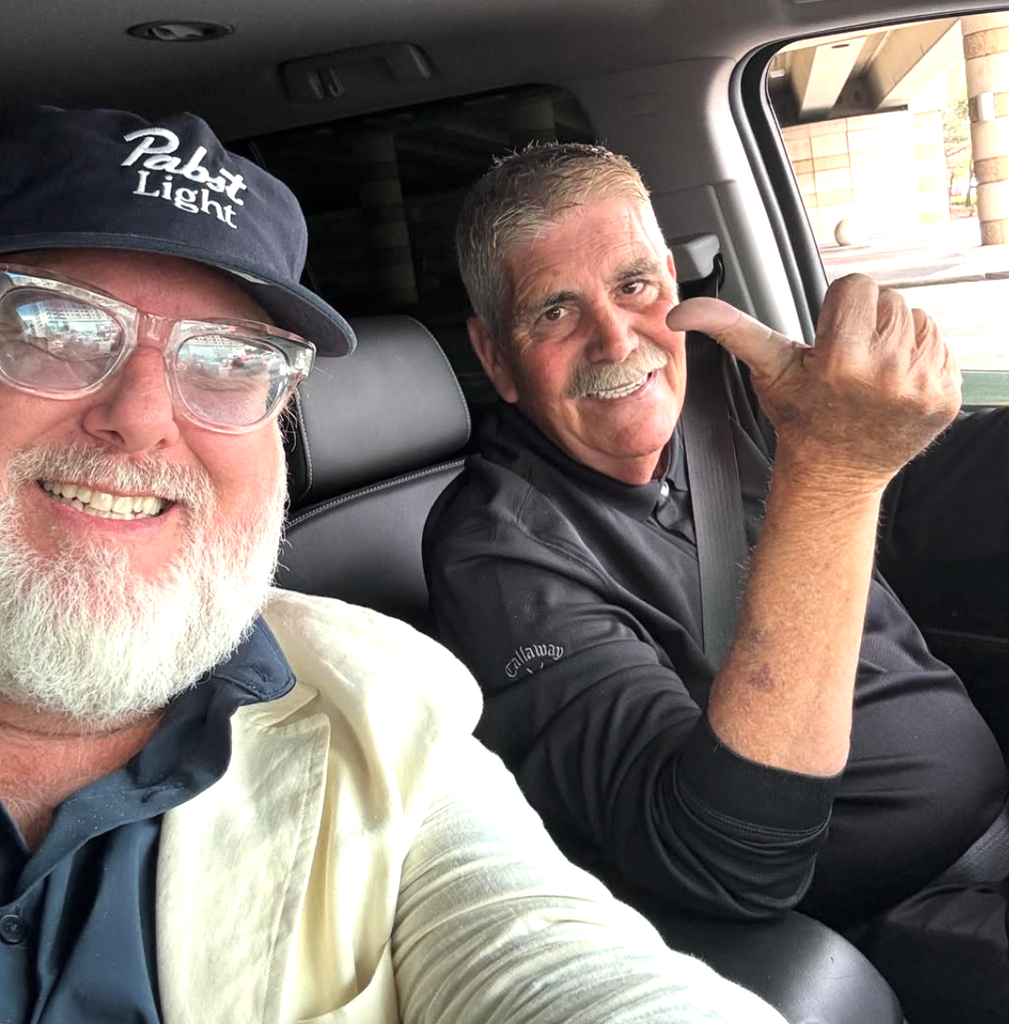
Our last meeting, in February 2025.
Until tomorrow,
Jenn, Jordan, Bianca, and Harry
“The reason lightning doesn’t strike twice in the same place is that the same place isn’t there the second time.” – Willie Tyler
============
SUMMIT RETURNING TO THE BREAKERS. Our 24th Annual Beer, Wine & Spirits Summit will be held January 18 – 19, 2027, and will return to the historic Breakers in Palm Beach, FL. Learn more and get your early-bird tickets here.
———- Sell Day Calendar ———-
Today’s Sell Day: 16
Sell days this month: 21
Sell days this month last year: 21
This month ends on a: Mon.
This month last year ended on a: Fri.
YTD sell days Over/Under: 0